
Caravan types by weight: registration plate, insurance, MOT and licence
Everything Spanish law asks of a caravan —registration plate, insurance, vehicle inspection and even which driving licence you need— hangs on a single figure: 750 kg. How to read it on the registration document, what changes either side of it, and why it is worth knowing before you buy or sign up for a season.
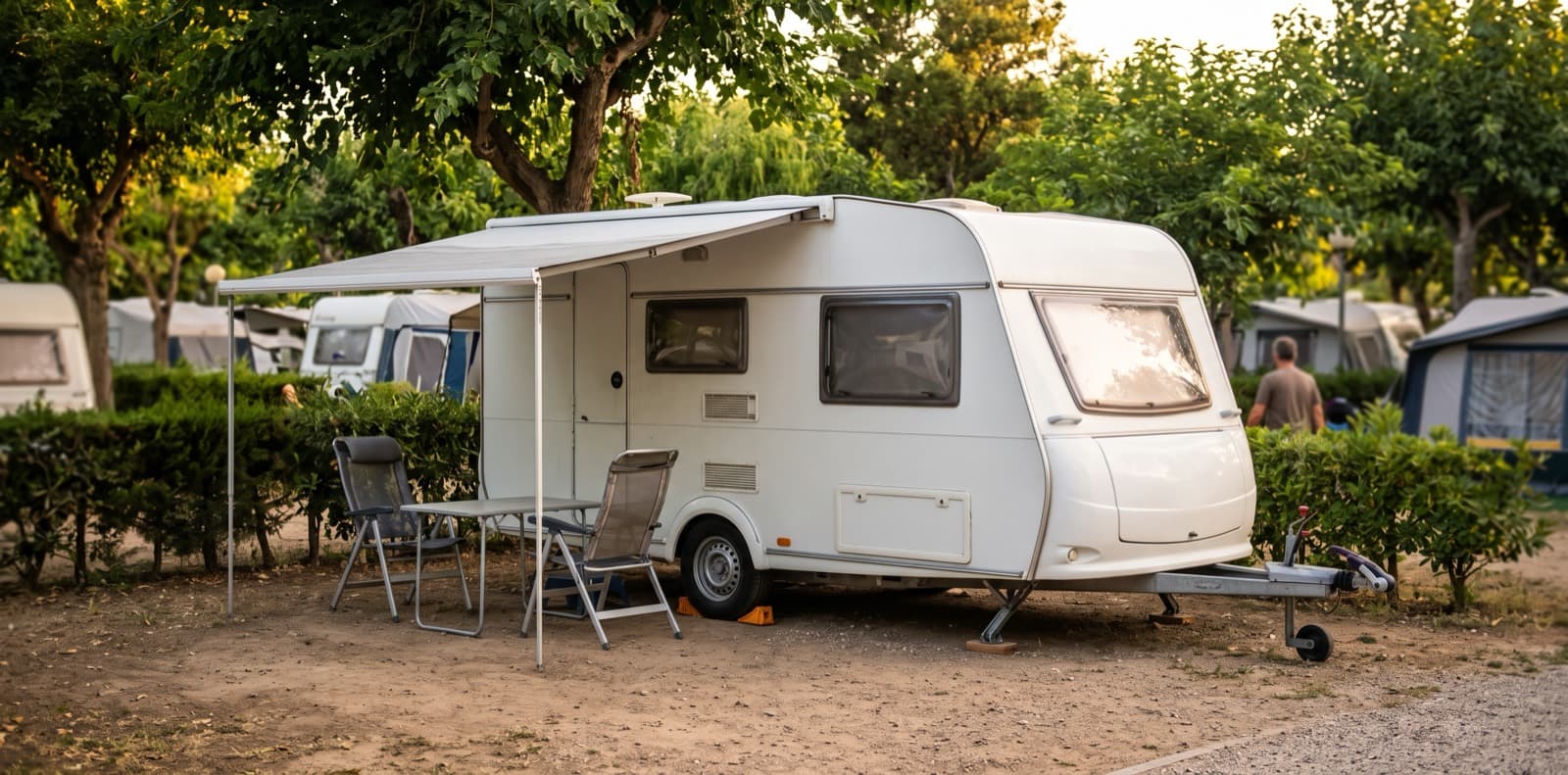
One figure decides almost everything: 750 kg
Two caravans that look alike at a glance can carry very different obligations. The difference is not the length or the price but a number on the registration document: the maximum authorised mass, or MMA in Spanish, which is the most that caravan may weigh when loaded. If it does not exceed 750 kg, it is a light caravan. If it does, it is a heavy one.
Note what is being measured: the authorised limit, not what it weighs today on your pitch. A caravan that weighs 600 kg empty but is rated for 1,000 is a heavy caravan for every purpose. And the other way round: travelling very light does not turn yours into a light one.
For anyone doing a season it matters twice. When choosing a caravan, because it decides which papers and which licence you need. And when choosing a campsite, because the weight and size of what you tow shape the pitch and the car you bring it and take it away with.
We are not lawyers or advisers. What follows is official rules and pages, quoted and linked, plus practical tips that we give as what they are: tips. For your own case, check the registration documents of your car and your caravan and, if in doubt, ask the DGT (Spain's traffic authority) or your insurer.
How to find what your caravan weighs (and what your car can pull)
It is all in two documents: the caravan's technical data sheet and the one for the car towing it. You do not need to be a mechanic, only to know which box to look at.
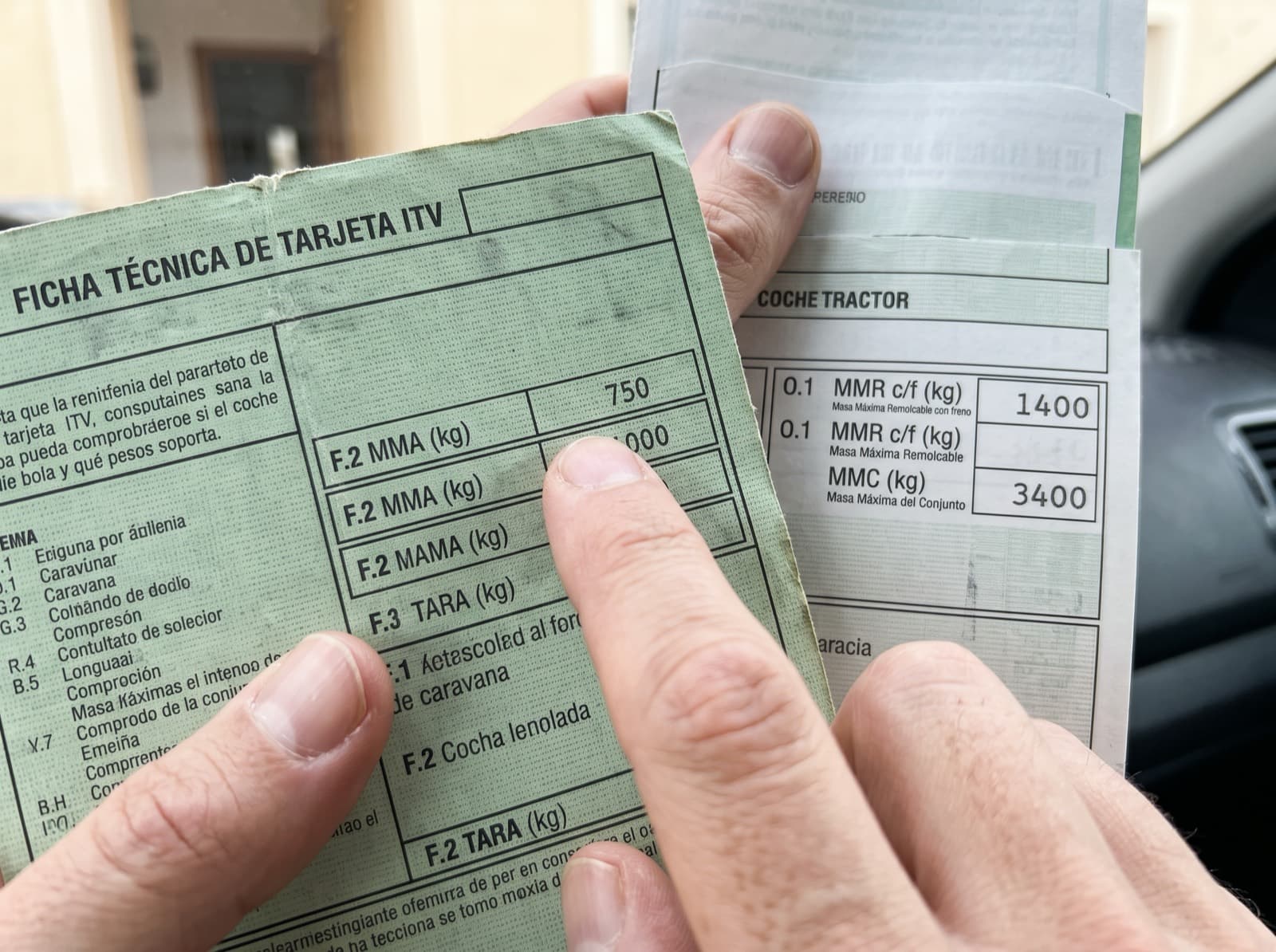
On the caravan's sheet the key figure is the MMA (box F.2). It is the limit you must not exceed once it is loaded for the trip. Beside it you will see the tare, which is what the caravan weighs empty from the factory, with no water, gas or luggage. Between the tare and the MMA lies the margin for everything you put inside.
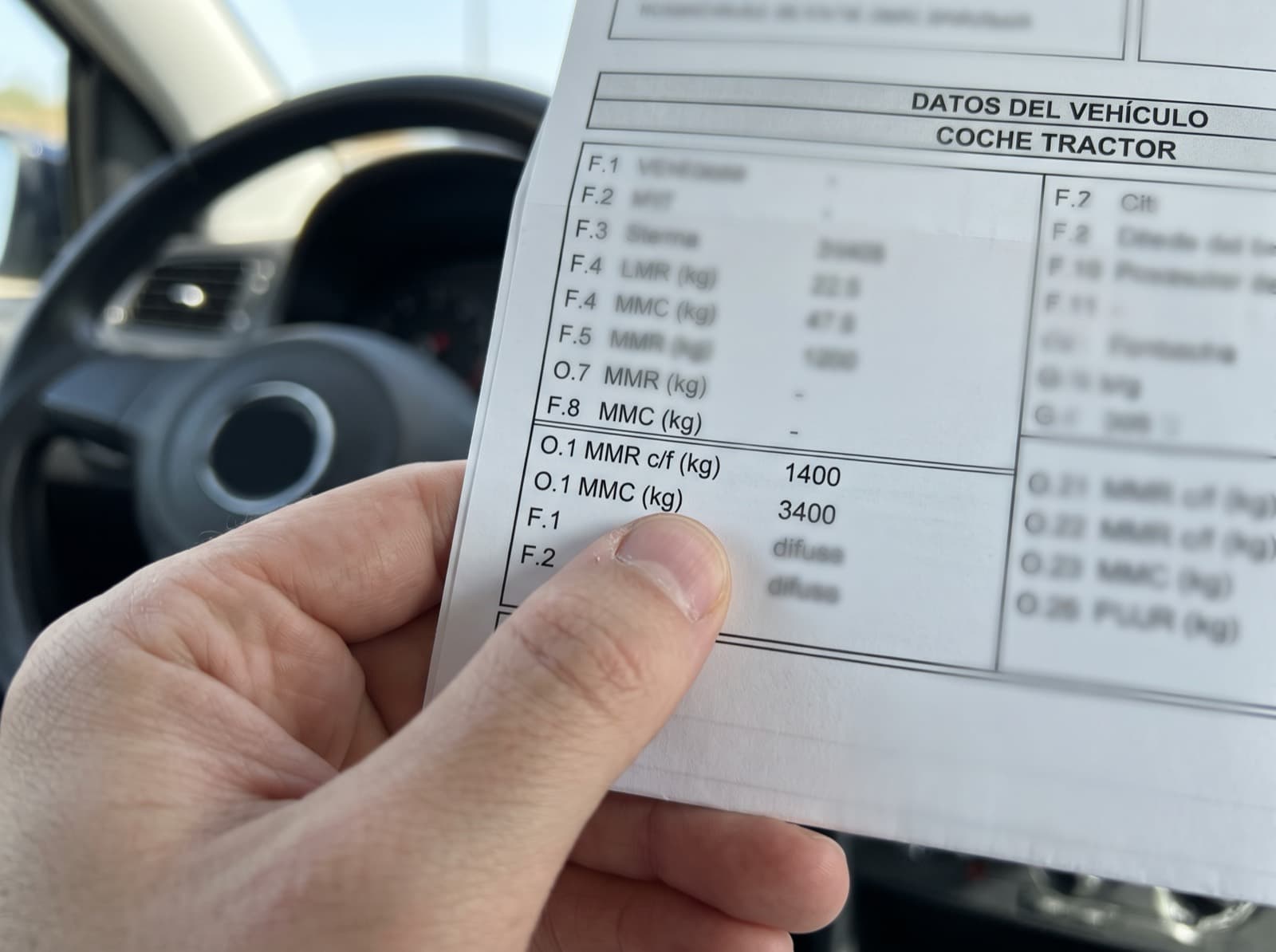
On the car's sheet, in the weights and towing part, two figures rule:
- MMR with brakes (O.1 MMR c/f): the maximum mass the manufacturer authorises it to tow. Your caravan's MMA must never be higher than this number.
- MMC (maximum mass of the combination): the most the car and caravan may weigh together on the road.
Practical tip, not a legal duty: the sheet says what the caravan may weigh, not what it really weighs. If you have added air conditioning, a motor mover, an awning or a full larder, the real weight is different. To find out, weigh it loaded on a public weighbridge or a farm cooperative's. Caravanners also commonly keep to no more than 85% of the car's kerb weight: it is a rule of prudence, not a regulation.
Light caravans: up to 750 kg MMA
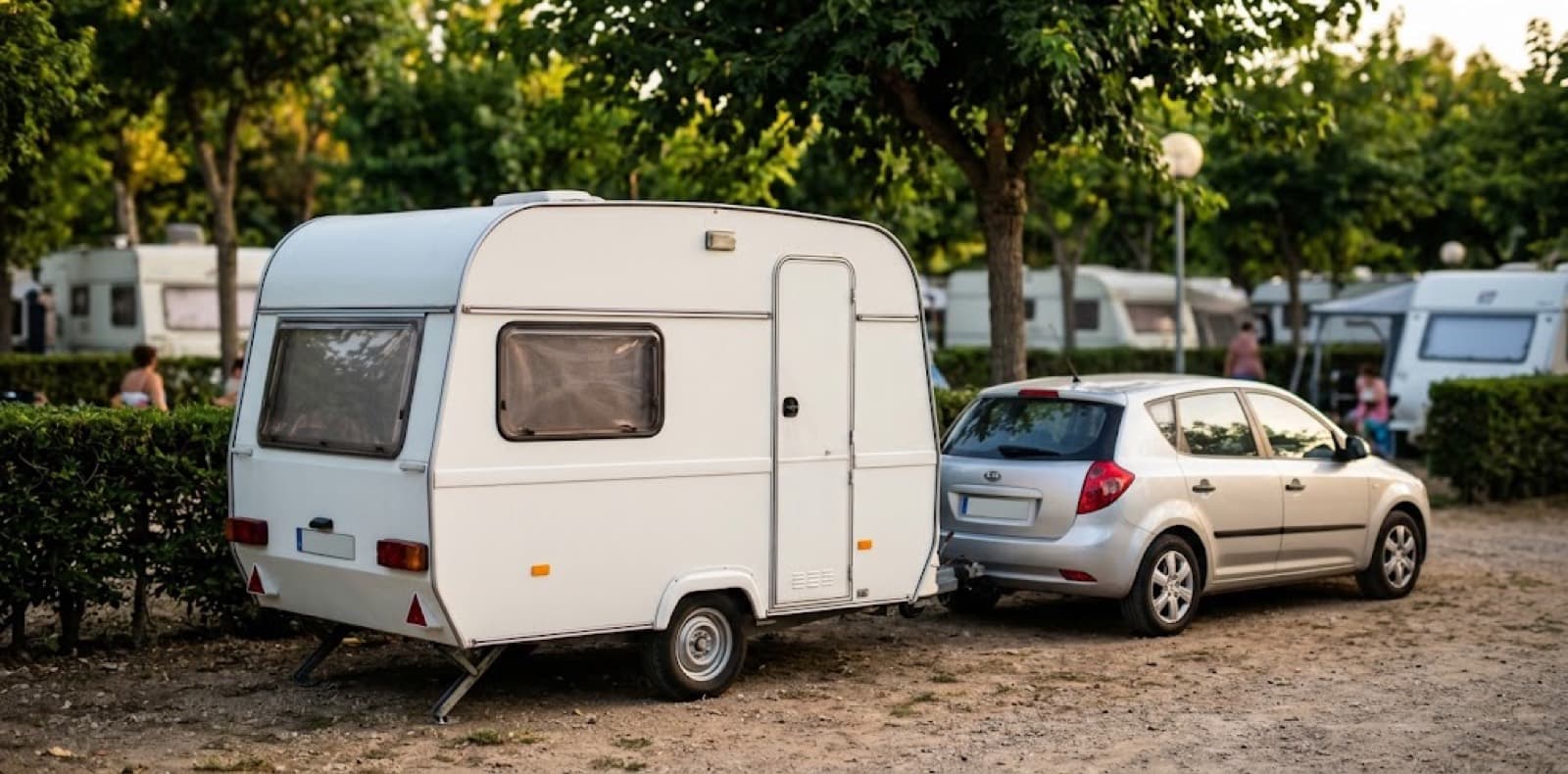
These are the small, compact ones, the ones you take on a road trip without thinking too hard. Their legal treatment is the simplest of all:
- Plate: they have none of their own. They carry the registration plate of the car towing them on the back.
- Insurance: they need no policy of their own, because the law leaves trailers of up to 750 kg outside compulsory insurance. It is prudent to tell your insurer that you tow a trailer, and check what it covers.
- Inspection: they do not appear in the table of periodic inspections. What does go through the inspection is the tow bar you fit to the car, which must be noted on its card.
- Licence: the ordinary B car licence is enough, as long as the car does not exceed 3,500 kg MMA.
Heavy caravans: more than 750 kg MMA
Nearly every medium and large family caravan falls here, including the ones you can live in comfortably for a whole season. Beyond 750 kg, the law treats them as a vehicle in their own right:
- Plate of its own: Spain's General Vehicle Regulations require trailers over 750 kg to be registered. The plate has a red background with black characters and the format R 0000 BBB, and it goes on the back together with a plate carrying the towing car's registration.
- Insurance of its own: compulsory. The motor liability law exempts only trailers not exceeding 750 kg, so above that figure the caravan needs its own third-party liability policy. Breakdown, theft or own-damage cover is optional.
- Periodic inspection: caravans are exempt up to six years and, from then on, are inspected every two years.
- Overrun brake: trailers over 750 kg carry one by their weight, and in practice that is what tells them apart at a glance from a light one.
- Licence: depends on what the car and caravan weigh together. We look at it in the next section.
A heavy caravan also needs the car's tow bar to be approved at the inspection station, just like a light one. It is the step most often forgotten when buying a second-hand caravan: ask whether the car you will tow it with already has it noted on its card.
Summary: light versus heavy
| Light caravan (up to 750 kg) | Heavy caravan (over 750 kg) | |
|---|---|---|
| Plate | The car's | Its own (red) plus the car's |
| Insurance | The car's, telling your insurer | Compulsory policy of its own |
| Inspection | Not in the periodic table | Exempt up to 6 years, every 2 years after |
| Licence | B | B, B96 or B+E depending on the weight of the outfit |
Which licence you need: B, B96 or B+E
The sum is simple, and uses two numbers from the data sheets: add the MMA of your car to the MMA of your caravan. That gives the maximum mass of the combination, and that figure decides the licence.
- Up to 3,500 kg for the outfit: the ordinary B licence will do.
- Between 3,501 and 4,250 kg, with a heavy caravan: you need the B96 authorisation. It is not a separate licence but a note on your B. You get it by passing a manoeuvres test: parallel parking and pulling out, and coupling and uncoupling the trailer.
- Above 4,250 kg: you need the B+E licence, the full trailer one, which lets a class B car tow a trailer of up to 3,500 kg MMA.
Three made-up examples, to see how it works. A car of 1,700 kg MMA and a caravan of 1,300 kg add up to 3,000: B is enough. An SUV of 2,100 kg and a caravan of 1,600 kg add up to 3,700: B96. A 4x4 of 2,400 kg and a caravan of 2,200 kg add up to 4,600: B+E.
If the caravan is light (up to 750 kg), B is enough with a car of up to 3,500 kg MMA; neither B96 nor B+E is needed. And beware a very common mix-up: the weight that counts for the licence is the MMA on the data sheet, not what the weighbridge reads that day.
Big twin-axle caravans: are they towed with B+E?
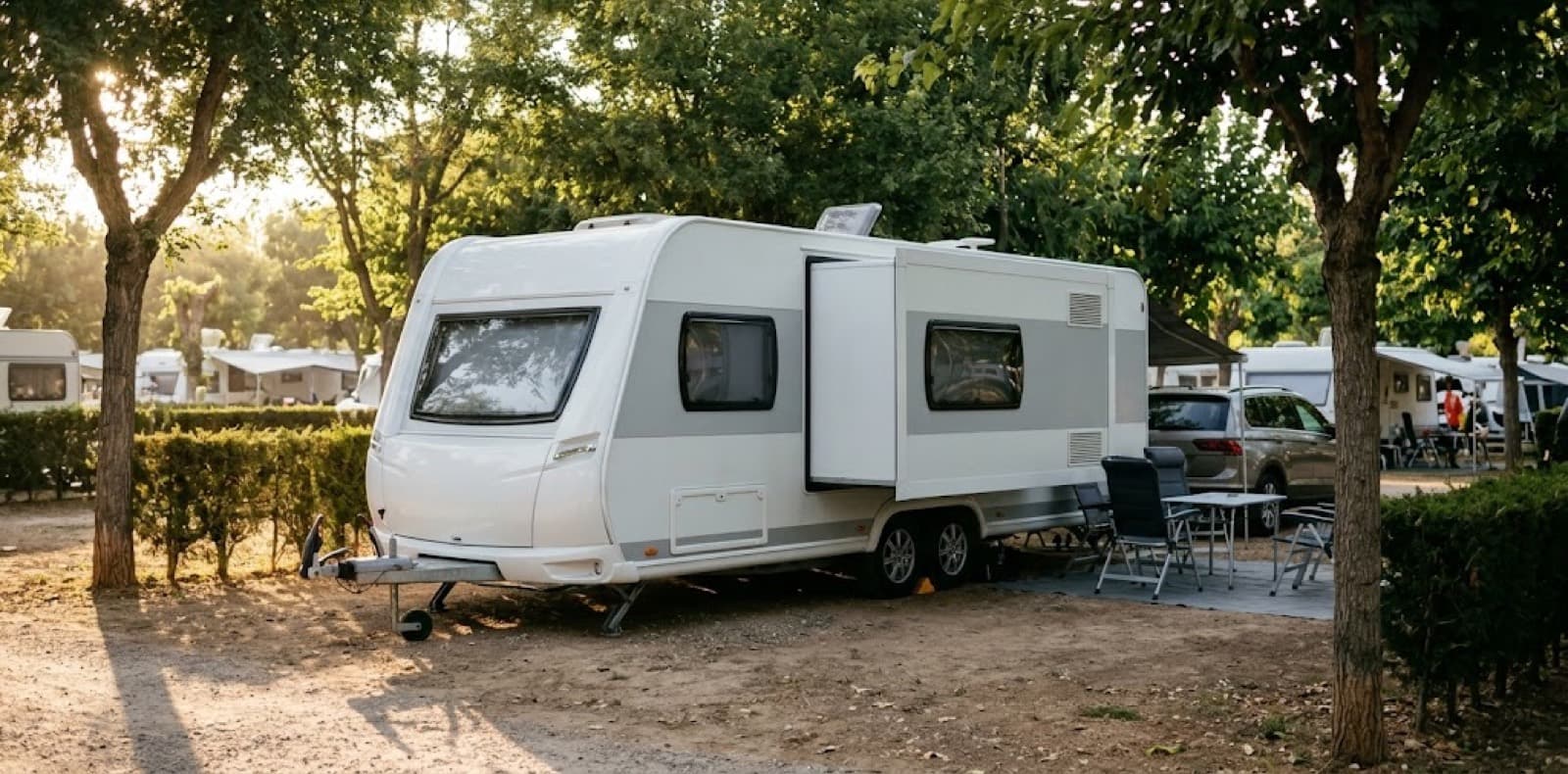
These are the long, twin-axle caravans that look like a house, the most comfortable for living many months on a pitch and also the hardest to move. At those weights the car towing them has to be powerful —a large SUV, a 4x4 or a van— and the sum of the two MMAs nearly always goes above 4,250 kg.
So in practice the answer is usually yes: they are towed with the B+E licence, provided the car is one you can drive with a B (up to 3,500 kg MMA) and the caravan does not exceed 3,500 kg MMA. As a sum: 3,500 for the car plus 3,500 for the caravan makes 7,000 kg for the outfit, which is the most the B+E gives in that combination.
If the caravan exceeds 3,500 kg MMA, or the vehicle towing it is a lorry or a bus, we are no longer talking about the B+E but about licences of another category. In that case, check with the DGT before buying anything.
A practical question that bears on seasons: a caravan that size needs a big pitch and room to manoeuvre. Before buying one, check the maximum dimensions the campsite where you plan to leave it accepts, and how you get into the pitch.
Size matters too: pitch and price
Weight decides the papers, but what decides whether you fit in a campsite is size. And it is not a matter of taste: a long caravan, with its awning and the car beside it, may not fit just any pitch, and not every campsite has large pitches.
- Fit: the pitches of one campsite are not all the same. Some are small, meant for a short caravan, and others much roomier. A long or twin-axle caravan needs the big ones, which tend to be fewer.
- Measurements that count: the caravan's length including the drawbar (the hitch section), its width with the awning or porch out, and room for the car. The length a manufacturer advertises rarely includes the drawbar.
- Access: not only the pitch matters but also the lanes. Narrow streets, tight bends or low branches can make it hard to get a big caravan in, even if the pitch itself is generous.
- Price: at some campsites the season price changes with the pitch's square metres, and a big caravan usually needs one of the dearest. Others charge by caravan size or add a surcharge, and others have a single price. Each campsite does it its own way.
So before choosing a campsite, measure your caravan for real (length with drawbar, width and height) and ask which pitch it would get and at what price. On the campingsdetemporada.es listings, the pitch's square metres appear on each rate when the campsite gave them to us, and any conditions that limit size, when there are some, in the small print.
This is not regulatory and there is no common figure: each campsite sets its own pitches and its own limits. The only way to know whether your caravan fits, and what it costs, is to ask the campsite.
What to check before you buy, or before you leave it at a campsite
- What is the caravan's MMA? Does it exceed 750 kg? Look at box F.2 of its data sheet.
- What is my car's MMR with brakes? The caravan's MMA cannot exceed it.
- What do the car's MMA and the caravan's add up to? That tells you whether B is enough or you need B96 or B+E.
- If it is heavy: does it have its own plate, valid insurance and an up-to-date inspection? If second-hand, ask for all three before paying.
- Does the car have the tow bar approved at the inspection station and noted on its card?
- What does it really weigh, loaded? One trip over a weighbridge settles it.
- If you plan a season: does the campsite accept this caravan's size on its pitch? Does it ask for any paperwork —insurance or inspection— to keep it there?
That last one, which papers each campsite asks for, is not regulatory and varies from campsite to campsite: it is a question for the campsite before you sign, like the others in our season guides.
Frequently asked questions
What is the difference between a light and a heavy caravan?
Its maximum authorised mass (MMA), the one on the technical data sheet. A light caravan does not exceed 750 kg MMA; a heavy one does. That figure decides the plate, the insurance, the inspection and the licence you need.
Does a caravan need a plate of its own?
Only if it exceeds 750 kg MMA. Then it carries its own red plate, in the format R 0000 BBB, plus the plate of the car towing it. A light one carries only the car's plate.
Do I have to insure the caravan separately?
If it exceeds 750 kg MMA, yes: it needs its own third-party liability insurance. Those not exceeding 750 kg fall outside compulsory insurance of their own, and it is prudent to tell your car's insurer that you tow a trailer.
How often does a caravan go through the vehicle inspection?
Caravans are exempt up to six years and, from then on, are inspected every two years. Separately, the car's tow bar has to be approved at the inspection station and noted on its card.
Which licence do I need to tow a caravan?
It depends on the sum of the car's and caravan's MMAs. Up to 3,500 kg the B licence is enough; from 3,501 to 4,250 kg with a heavy caravan, the B96 authorisation; and above 4,250 kg, the B+E licence. With a light caravan, B is enough with a car of up to 3,500 kg.
Is a big twin-axle caravan towed with the B+E?
Usually yes, as long as the car is one you drive with a B and the caravan does not exceed 3,500 kg MMA. If the caravan exceeds that, or the tow vehicle is a lorry or a bus, licences of another category are needed: check with the DGT.
Compare seasonal campsites in Spain
Real season prices, asked campsite by campsite, with the detail of what each rate includes.
Browse campsites