
Can you live on a campsite?
Not spending a summer: leaving the caravan on a pitch for ten, eleven or twelve months and using it as your home. It is the most asked question and the worst answered, partly because the answer is not the same across Spain.
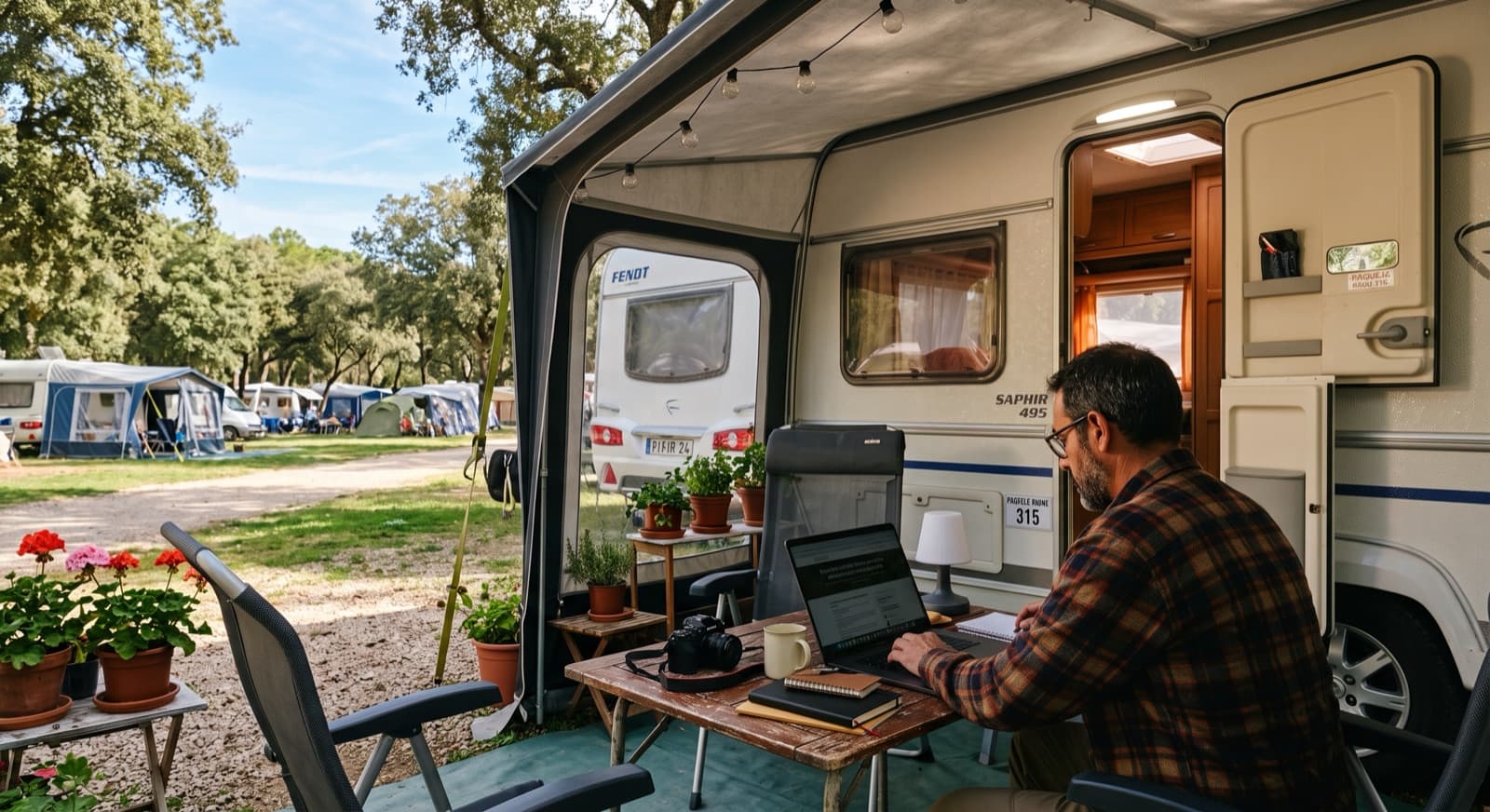
A season and a home are not the same thing
Before looking at any rule, two sentences that sound alike need separating: "my caravan is on a campsite for eleven months" and "I live in that caravan for eleven months and it is my usual residence". The first describes a pitch contract. The second describes a home, and it is the one that opens every question: tourism rules, town-hall rules, the campsite's own licence and whatever the contract you are about to sign says.
Almost everything written about this mixes the two. A campsite selling you a twelve-month season says nothing about whether you can register as a resident, or whether that pitch may be your home. Those things are decided elsewhere and for different reasons.
We are not lawyers or advisers. What follows is official documents, quoted and linked, plus the one thing we can check first-hand: exactly what the campsites we publish are selling. For your own case, ask the campsite and your town hall.
Where the six-month figure comes from
It is the number that turns up in every forum, and it does come from somewhere real: Royal Decree 2545/1982, on the creation of tourist campsites. Its article 2 says that establishments "where users contract their accommodation for longer than six months, whatever the form of contract" shall not be considered tourist campsites and are therefore not subject to that Royal Decree.
Read it again, because the difference is the whole guide: that forbids nobody anything. It says what the rule covers and what it does not. An establishment where people contract for more than six months falls outside that decree's definition of a campsite; it does not say the customer is committing an offence, or that you must leave after six months.
And it is a 1982 rule, older than the regional development of tourism law. Campsites today are regulated mostly by the autonomous communities, so the answer changes with where the campsite is — and town-hall and planning rules can sit on top of it.
What the rules say in Catalonia
Since every campsite we publish is in Catalonia, this is the one that applies here. Catalan tourism is governed by Decret 75/2020, and the Generalitat's own FAQ on that decree answers exactly this — in two halves.
First half: there is no maximum stay. Nobody is going to tell you to move the caravan after six months. Second half, in the same sentence: tourist accommodation establishments "cannot become the principal or secondary residence of tourist users, in any case".
So: staying a long time, yes. That being your home address, no. It is the distinction from the first section, written into the rule that applies to the campsites you are looking at.
Registering as a resident is a separate matter
Here is the twist that catches most people out. Spain's Padrón Council, which settles questions about the municipal register of residents, dealt specifically with registering someone at a campsite, and its view runs the opposite way to what you would expect: the register must reflect where people actually live, not what tourism rules count as legal housing.
It quotes an earlier ruling that puts it bluntly: substandard dwellings — shacks, caravans, caves, even no roof at all — can and must appear as valid addresses on the register, because sometimes that is the reality. And it adds that a campsite's internal rules banning registration do not change that: if the person habitually lives there, that is where they are registered.
But being able to register does not give you the right to live there. The register records a fact — where you are — and tourism rules govern something else: what may be sold and for what. A town hall registering you does not turn the pitch into legal housing.
What campsites actually sell, which we can check
Documents up to here. What follows we counted ourselves, listing by listing, across the 52 Catalan campsites we publish with a season price as of September 2026. It is the part that points hardest, because even if the rules were a clear yes, there would still be what the campsite is selling you.
Forty-one sell an annual pitch season. But "annual" means the caravan stays on the pitch for twelve months, not that you can go: eighteen of those forty-one only entitle you to come at weekends, on long weekends, on public holidays and during school holidays. Not on a Tuesday in October. And of the rest, many close for a few months in winter: the caravan stays, but you cannot get in.
If what you want is to use the pitch in any month of the year, the list drops to ten campsites. And if you also want to go on any day, not just weekends, it drops to three out of fifty-two. None of the three sells it as housing: they sell it as a long-stay pitch, by the month or by half-seasons.
They are three separate questions and worth asking separately: does the caravan stay for twelve months? is the campsite open twelve months? can I come on any day? A yes to the first with a no to the other two is the commonest case of all.
Why many close for a few months
It is tempting to join the dots and conclude they close in winter so that nobody ends up living there. We have found no basis for saying so, and we are not going to say it.
The reasons you can actually see at the campsites are more mundane: there are no customers in the mountains in January, keeping the toilet blocks and reception open costs money, building work and reseeding only fit outside the season, and each establishment's licence may set its own calendar. A Pyrenean campsite closing for three weeks in January and a coastal one closing from November to February are not doing the same thing for the same reason.
What is worth holding on to is the practical consequence, which does not depend on the reason: if the campsite closes, you cannot be there those months, even if you paid for a season called annual and even if your caravan is still on the pitch.
What to ask before you sign
If you came here for a yes or a no, our reading — with all the caveats of people who are not lawyers — is that it looks more like a no than a yes, and less because of a clear ban than because of two more down-to-earth things. One: in Catalonia the rule says explicitly that a tourist establishment cannot be your residence. Two: hardly any campsite sells something that works as a home, because nearly all of them limit the days or close for months.
Between "I spend many months here" and "this is my home" there is a genuinely grey area that depends on the region, the town, the campsite's licence and your contract. Nobody is going to settle it over the phone in five minutes. What you can do is ask the right things:
- Which days does the season entitle me to come? All of them, or weekends, public holidays and school holidays?
- Does the campsite close at any point? Can I come in during the closure, or does only the caravan stay?
- Do you allow habitual residence, or is the pitch strictly for tourist stays?
- What does the contract say about registering as a resident and about the maximum number of consecutive nights?
- Does the caravan have to be removed at any point in the year?
Asking "do you have annual pitches?" will not get you there: almost everyone will say yes, and they will be answering a different question. The question is whether they allow habitual residence.
Frequently asked questions
Is it illegal to live on a campsite?
No national rule says so in those words, and the answer depends on the region, the town and each campsite's licence. In Catalonia, the Generalitat's FAQ on Decret 75/2020 says there is no maximum stay but that a tourist accommodation establishment cannot become the user's principal or secondary residence, in any case.
Where does the six-month figure come from?
From article 2 of Royal Decree 2545/1982, which excludes from the definition of a tourist campsite any establishment where accommodation is contracted for more than six months. It is a rule about what that decree covers, not a ban on the customer, and it dates from 1982, before regional tourism law developed.
Can I register as a resident at a campsite?
Spain's Padrón Council has addressed the case, and its view is that the register reflects where a person actually lives, to the point of accepting a caravan as an address. But being able to register does not give you the right to live there: the register and tourism rules are different things.
Are there campsites where the pitch can be used all twelve months?
Yes, but few: ten of the fifty-two we publish as of September 2026. And of those ten, five only entitle you to come at weekends, on public holidays and during school holidays, and a sixth limits it that way from October to February.
What should I ask the campsite?
Whether they allow habitual residence, which days the season entitles you to come, whether the campsite closes at any point, and whether you can come in during the closure or only the caravan stays. Asking only whether they have annual pitches will not do: almost everyone will say yes and be answering something else.
Compare seasonal campsites in Catalonia
Real season prices, asked campsite by campsite, with the detail of what each rate includes.
Browse campsites