
What campsites ask of you for a caravan season, and the community rules to follow
Before you leave a caravan on a pitch there is paperwork and an installation to check: insurance, gas, extinguisher, deposit. After that, pitch and community rules that each campsite sets its own way. Here is what repeats and what changes from one to the next.
First: each campsite's contract rules
A campsite is not a home rental: there is no common rule on what they can ask of you. What each one requires is in its seasonal contract and its internal rules, handed over or shown at reception when you sign. That is why this guide describes what repeats, not what you will be asked.
It comes from three places: the conditions on this site's listings, a reading of seasonal contracts and internal rules, and one campsite chain's good-practice guide. It is almost never on the campsite's own website, which gives the price but not the small print, so ask for the contract and the rules before paying anything.
The five things almost everyone asks for
- Third-party liability insurance for the caravan, with proof of payment showing the caravan's details. Some campsites also want theft and fire cover; one chain recommends at least €150,000 of liability cover. You usually have to leave a copy at reception.
- A certificate for the gas installation: the inspection must be current and signed by an authorised installer or company. Some campsites only ask for it if you carry large cylinders (15 kg or more), and others cap cylinders at one per pitch.
- A fire extinguisher in the caravan, of sufficient capacity and in good working order. Our listings record it for only one campsite, because these requirements are spelled out in the contract or the internal rules and not when the price is given; people with a season take it as standard.
- A deposit, normally to cover cleaning the pitch and the meter key. On our listings it runs from €100 to €700 —or one month's fee— and is returned at the end of the contract if the pitch is left clean and empty. Some campsites do not ask for a deposit, and their listings say so.
- If you bring a dog, a current vaccination certificate or record. There is nearly always more: the dog is kept on a lead, registered at reception, sometimes charged a supplement, and potentially dangerous breeds are not accepted.
On top of that they ask for the ID of the holders and everyone registered, and for you to sign the contract and the internal rules. Some campsites also want a visit or an interview first, and a request the management approves.
What only some campsites ask for
This is where choosing gets tricky, because these are rules you will not see on the sales listing. The ones that repeat most:
| Topic | What we have seen | What to ask |
|---|---|---|
| Caravan age and size | No caravans over 10 years old, or over 7 m; at others the caravan only has to be in good condition with its papers up to date. | Maximum age, maximum length including the drawbar, and whether they want photos or the technical sheet. |
| Pitch and awning flooring | No artificial grass, carpets, decking, laminate or built paving; the awning floor must be camping tiles. Many look after the natural lawn. | Which flooring is allowed and whether the natural lawn must be kept. |
| Barbecues | It varies a lot: some ban them on the pitch and allow only the designated areas, some allow gas only, others add charcoal, and wood, mineral coal and built barbecues are almost always banned. | Whether you may have one on the pitch, and of what type. |
| Pallets and items under the caravan | Nothing may be stored under the caravan, nor pallets or decking with wooden boards laid in the awning; at some, no belongings in view either. | What may be left outside and what must stay inside. |
| Awnings, tents and shades | One awning, and at most one kitchen tent of set size (for example 3 × 2 m); closed over-awnings, extra tents and sheds are out. Some only accept horizontal awnings of a single colour. | Sizes, colours and how many items are allowed. |
| Pitch boundaries | Nothing may stick out; a minimum is left between units (50 cm is usual) and at some the car must fit inside. | How much clearance there is and where the car is parked. |
| Electricity | Earthed cable in a single run, sealed connections, no power strips or insulating tape, and a maximum power per pitch. Outdoors, some require a CETAC adapter. | Amperage, maximum power and which connector to bring. |
| Visitors and second car | Visitors are registered at reception and usually pay; a second vehicle must appear in the contract. Some accept no visitors. | How many visitors, at what price, and where they park. |
| Selling or transferring the caravan | The contract is personal. At some you cannot sell the caravan where it stands or hand the contract on. | What happens if you sell the caravan mid-season. |
The end of the season differs too: some let the caravan stay even when the campsite closes, others require you to take it out or strip the awning, and some charge for each item left in view out of season. The sooner you ask, the fewer surprises.
Good practice on the pitch
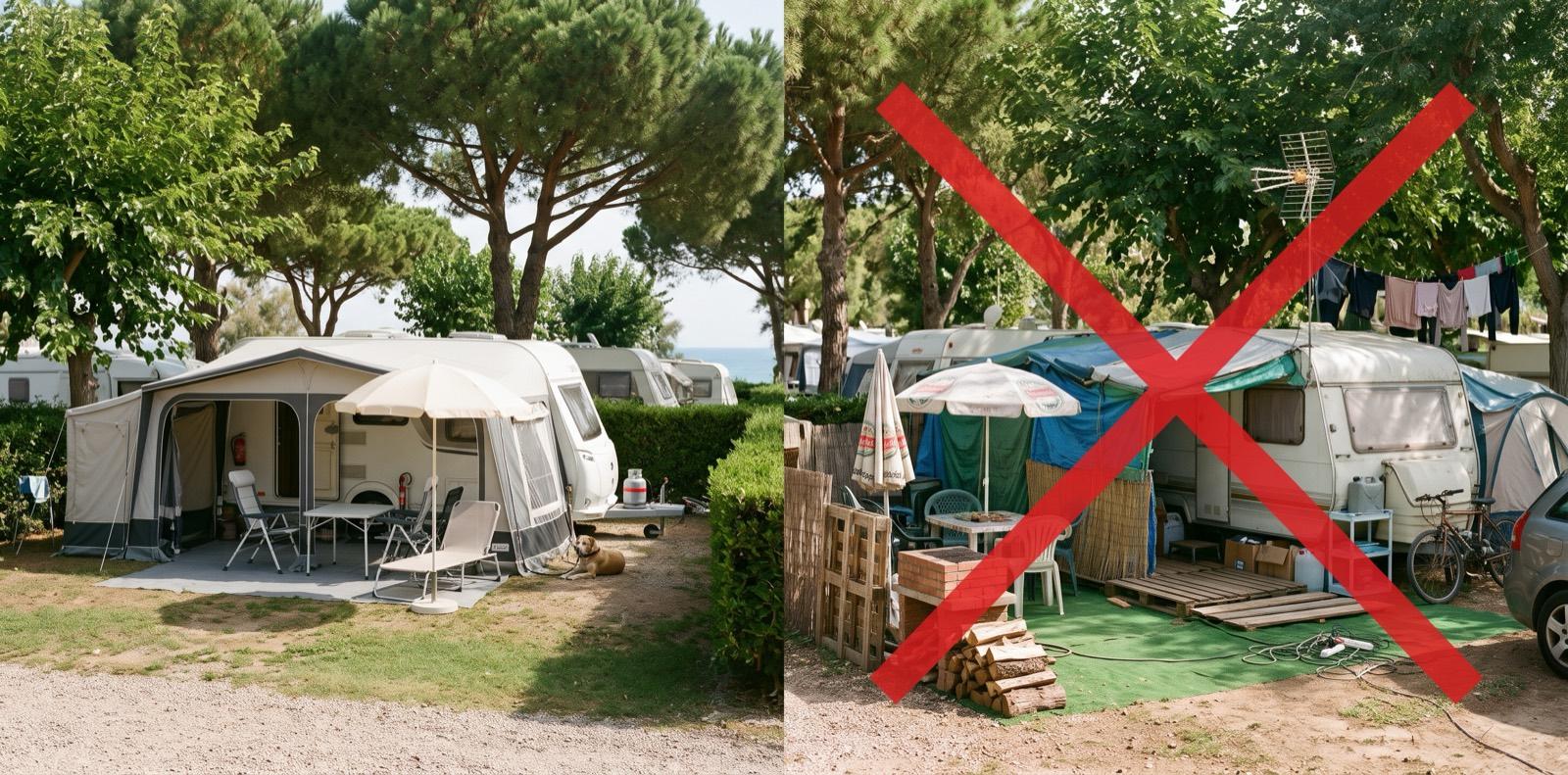
Almost every set of rules agrees on the idea: the pitch is part of the campsite's landscape and has to look tidy, with camping-type items —mobile, light and easy to transport— and no building work or fixed elements.
- What is usually allowed: a caravan with its awning, a camping table and chairs, loungers, a light-coloured parasol, a kitchen tent with the appliances inside, and little else. Up to a couple of plant pots, if you have asked.
- What is usually banned: fences, hedges or enclosures; tarpaulins and woven plastic sheeting in view; furniture that is not camping furniture (wood, rattan, iron) and swings; TV aerials fixed to the ground or to trees; planting in the ground; outdoor showers or taps; a second kitchen; jerrycans, drums and shelving in view.
- Do not nail or hang anything on the trees: no ropes, clotheslines, floodlights or aerials.
- Pitch lighting: bulbs with shades so they do not dazzle other pitches, below two metres high, no garden lanterns, and with appliances earthed.
- When you finish setting up, tell reception: at many campsites someone checks that the installation complies.
Safety: gas, electricity and fire
- Gas: an inspected installation with a current certificate; the campsite's gas is used only where permitted.
- Electricity: one single connection from the outlet, no splitters or adaptors; cable with no joins, earthed and properly insulated; sealed outdoor connections; never power strips or insulating tape. Stay within your pitch's maximum power.
- Fire: open fires are banned on the site. Where barbecues are allowed, they must be mobile and approved, never built-in or made from the parts of other appliances.
- Do not store firewood, timber or other flammable material inside the unit.
- An extinguisher in good condition, and everything you install should resist fire well.
Living together: noise and traffic
- Keep to rest and quiet hours. Loud music, TV or radio draws complaints and, in some rules, expulsion.
- Drive slowly on site —10 km/h at some— and many campsites limit or ban cars at night and ask you to park in a shared car park. Bikes are for strolling, and mopeds and electric scooters are banned at some.
- Children are their parents' or guardians' responsibility. At many campsites minors may not stay alone on the pitch or use pools and washrooms alone.
- Visitors are always registered at reception, even if they do not stay the night. Letting someone in unregistered is among the most serious offences.
- Stick to the number of people named in the contract: it cannot be changed without the campsite's approval.
- Join in the campsite's activities if you fancy it: it is the easiest way to meet your pitch neighbour.
With a dog: on a lead at all times, including inside the pitch, never alone, picking up after it and keeping it out of washrooms and pools. At many campsites you also have to register it at reception and show its health papers.
Water, waste and hygiene
- Waste water goes only in the designated points: not on trees, not on your pitch, not elsewhere. In the washrooms, only in the chemical toilets provided.
- No washing up or laundry at the drinking fountains: each campsite has sinks and laundry areas for that.
- No hosing down or watering on the pitch, and small water containers (under 10 litres) are what is accepted, apart from the caravan's own tank.
- Rubbish: in its bin and at its time —at some, organic waste can only go out between evening and early morning— sorting organic, packaging, glass and paper. Large bags do not go in the litter bins; furniture, mattresses and appliances go to the municipal recycling centre.
- Switch off lights and appliances when you leave the pitch, and use only the water you need: it is a limited resource.
What can get you expelled
Seasonal contracts usually list what counts as a serious offence: not being up to date with payment, not identifying yourself or not registering a visitor, a fight or brawl, music or loud noise, theft or mistreating the facilities, and ignoring staff instructions. Some sum it up as breaching the rules. Typically a serious breach lets the campsite terminate the contract and remove the caravan from the pitch.
Two reminders from the contract: pay on time —non-payment can end the contract— and leave the pitch empty and clean at the end. If you do not, some contracts allow the campsite to remove your things and bill you for it, which can be a lot of money.
Quick checklist before you sign
- Third-party liability insurance for the caravan in place, and the proof of payment to hand.
- Gas installation certificate, current and signed by an authorised installer.
- Extinguisher checked and kept inside the caravan.
- Your dog's vaccination record, if you bring one.
- ID of the holders and everyone being registered, and the registration plates of the vehicles.
- Money for the deposit and the first payment.
- The contract and the internal rules read, with the caravan's maximum age, the pitch dimensions, and the rules on awnings, flooring and barbecues.
Frequently asked questions
What insurance do I need to leave a caravan on a campsite?
Almost always third-party liability, and some campsites also want theft and fire. They ask for proof of payment showing the caravan's details, and sometimes a copy at reception. One campsite chain recommends at least €150,000 of liability cover.
Do I need a gas installation certificate?
It is one of the most repeated requirements: a current inspection signed by an authorised installer. Some campsites only ask for it with cylinders of 15 kg or more, and others limit the number of cylinders per pitch.
Do they ask for a fire extinguisher?
In practice yes, though it almost never appears on the website: it is detailed in the contract or the internal rules. It must be of sufficient capacity and in good condition.
How much is the deposit for a season?
On this site's listings, from €100 to €700, or one month's fee. It is usually returned at the end if the pitch is left clean and empty. Some campsites do not ask for a deposit.
Can I keep a dog on the pitch?
At most, yes, with conditions: on a lead, registered at reception, with an up-to-date vaccination record and sometimes with a supplement. Potentially dangerous breeds are not accepted, and some campsites accept no dogs at all.
Can they ask me to change my caravan for being old?
Some campsites set an age limit —10 years is the cut-off we have seen most— or a length limit, and others only ask that it is in good condition with its papers up to date. Ask before you buy one.
Can I lay artificial grass, decking or a built barbecue?
At most campsites, no: they want mobile, light items, not building work or fixed flooring. For the awning floor they ask for camping tiles, and built, wood or mineral-coal barbecues are almost always banned. Each campsite decides, so ask.
Compare seasonal campsites in Spain
Real season prices, asked campsite by campsite, with the detail of what each rate includes.
Browse campsites